


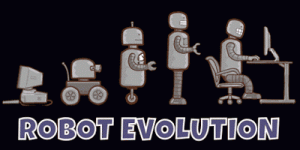
I was reading the other day about how robots are taking over our jobs, and I began to wonder how many of my past jobs already have been taken over by robots. My first job was selling seeds door to door. If I sold enough seeds, I would win an air gun. After World War II, all the boys wanted guns. Now, if people want seeds, I’m supposed to get it from Amazon. One job bites the dust.
Second job was as a newspaper boy. No more newspaper boys. Not many newspaper jobs. Not even many newspapers. Now we get our news, fake or real, on the Internet. Two jobs down.
Next job was as a caddy, carrying the clubs for a lot of guys who looked like Rodney Dangerfield. If you think about the golf cart as a robot, that job is long gone, too!
Next, I drove a Vernors Ginger Ale pop truck. From what I hear, truck drivers are probably the next to go with self-driving trucks soon on the way. Real Detroit Vernors is gone, too, just like Stroh’s beer. That’s three jobs gone.
Out of college I was a teacher in Harlem for a few years. While we still need teachers, they are no longer well respected, and there’s going to be more learning through digital devices. Another job bites the dust.
For a long time now, I’ve been a psychologist. First, clinical, and for the last several years, as an organizational psychologist. I’m also a teacher and a writer. I’d like to think that there is no way robots will be taking over these jobs. They require a high degree of emotional intelligence. From what I’ve heard, artificial intelligence does not come anywhere near understanding or replicating emotional intelligence. That’s not to say it will not happen. I predict that within my grandchildren’s lifetime, robots will learn to replicate psychology, too. Already, we have computer apps that simulate the therapy process. We have online classes. We even have software that can write reasonably well.
So as an exercise, try answering the questions below:
- How many of the jobs that you did in the past are now done by robots?
- How long do you think it will be before robots can do the job that you are now doing?
- Can you imagine facing the future where most of us do not have jobs?
- How will you spend your time when a robot takes over your job?
Below, I am sharing an article about how robots threaten to take over the jobs we hate, and what I think we can do about it. It was written by my friend, Lawry Dolph.
Anxious? Fearful? Depressed?
The Job You Hate May Be Eliminated Soon!
New Book from Rob Pasick and Dunrie Greiling Will Help
February 14, 2017, Ann Arbor, Michigan, PRNewswire—The good news is that the job you hate is about to be automated. The bad news is that you’re about to be out of work.
Journalists fear computers that are already writing news stories. Truck drivers fear self-driving trucks, already carrying freight in controlled experiments. Accounting, lawyering, health care, package delivery, even Uber driver jobs are on the verge of automation.
“Jobs that cannot be automated are on a very short list. If you are afraid to leave the job you hate, it may be about to leave you,” notes Robert Pasick, PhD, an executive coach and organizational psychologist who also teaches at the University of Michigan’s Ross School of Business.
“In part, this is because the economy is too dynamic,” Dr. Pasick reports. “Big companies are seeking technology-enabled gains for stakeholder profits. Leading companies are finding opportunities to reduce their US workforce by as much as 90 percent.”
“In part, this is because the economy is not dynamic enough. There are less than half the new companies creating new jobs than there were 37 years ago.
“In all this chaos,” Dr. Pasick argues, “we must focus on what we can control. Self-awareness and emotional intelligence are the keys to any individual’s future success.”
There is no arguing with the medical data. Depression causes overall body aches, low energy and poor job performance. Anxiety creates awkward movements from stiff muscles, jaw pain and headaches. Both increase the risk of developing diabetes and heart disease.
It is hard to look good in a job interview when you have one or more of these symptoms.
“Start by attending to your own well-being,” Pasick says. “Only when you understand and manage yourself can you influence the world around you. This is why I have written Self-Aware: A Guide for Success in Work and Life. I wanted to draw on everything I have learned in 45 years as a practicing psychologist and professor to help people develop themselves, understand their relationships, set goals, and meet them.”
Co-authored with Dunrie Greiling, who holds a doctorate in Ecology and Evolutionary Biology, the 139-page book reveals life as a balancing act:
“We can look at each of the things that define our life and affect our health: Friends and community, work, self, family, health, and integrity. This is our personal ecosystem. If any of the connections are strained or have a problem, we experience tension and stress, and we begin to die, both as an organism and in the job market.”
With accessible and transparent language, the book Self-Aware offers lessons with analytical exercises to identify and isolate the problem areas in anyone’s personal and professional life and how to work to successfully solve them.
“Almost anything can be resolved if you isolate the problem and set a course of action. Acting will make you feel better immediately. But if you remain in denial and do nothing, chances are the problem will eat away at you,” Dr. Pasick says.
Growing up in the shadow of the Great Depression, a young Rob Pasick was taught by his parents that any unhappiness they experienced came from a lack of money. Yet in a distinguished career as a practicing psychologist and professor following his PhD at Harvard, Pasick has learned that is not true for many people.
“Research on happiness shows that beyond a minimum amount of money to keep us fed and housed, additional money does not make us any happier. Yet we still operate under the myth that making a lot of money will be the key to happiness.
“In a social and cultural environment that is changing almost at the speed of light, I wanted to write a book that will help men and women of all ages, adapt, thrive financially and physically, and be happy,” Dr. Pasick says.
“Self-awareness is never wholly about ourselves. We mostly learn about ourselves in relation to others,” Dr. Pasick says.
“It is our relationships with others that will lead us to new companies where productive human relationships out-perform any automated machine.”
FOR MORE INFORMATION: Contact Dunrie Greiling, PhD, 734.276.3873, dunrie@scientificink.com